World-class environmental research platforms for a sustainable society

SAEON

South African Environmental Observation Network (SAEON) is a long-term environmental observation and research facility of the National Research Foundation (NRF). SAEON’s three focus areas are environmental observation, data management and education outreach. The Department of Science and Innovation provides core funding for these activities. 

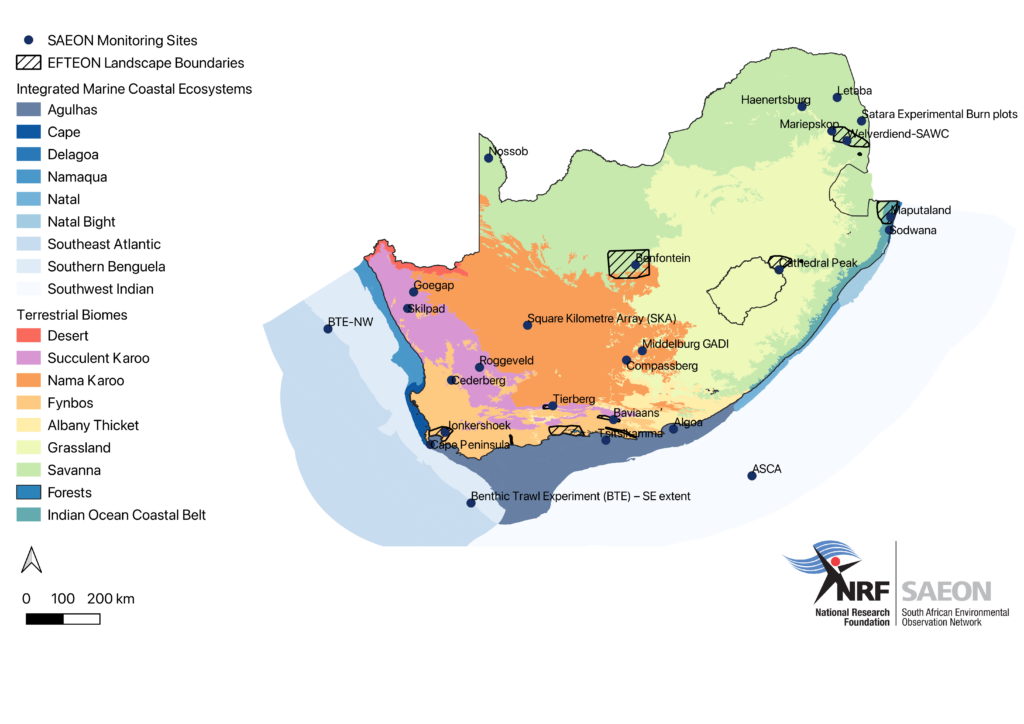
SAEON has a distributed network of seven nodes, three research infrastructures and a national office. The research network covers the major terrestrial and marine ecosystems in South  Africa and supports well over 100 researchers and students a year.

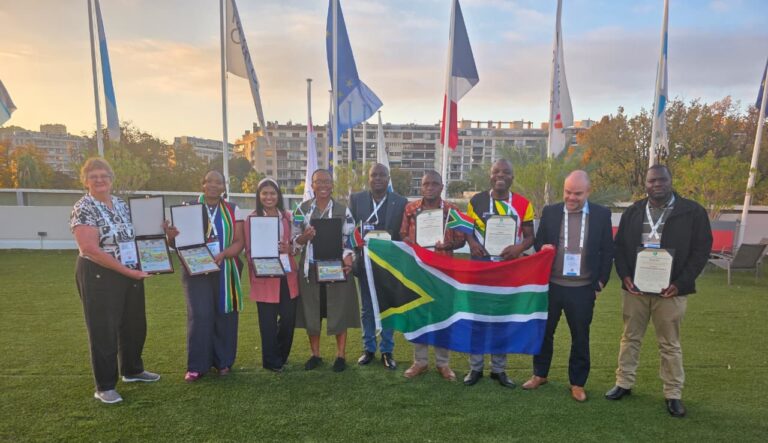
Reflecting on 21 years of NRF-SAEON

Latest Seminar

Title: Griqualand West: What can the past tell us about the future?
A journey from plant communities to functional traits in a changing landscape

Presenter: Dr Nanette Van Staden (NRF-SAEON Arid Lands Node & North-West University)

Griqualand West (GW) is a region with a rich history and heritage, important for South Africa’s meat production and increasingly associated with renewable energy. Botanically, GW is a diverse landscape harbouring distinctive plant communities shaped by heterogeneous topography, geological substrates and climate. Its flora includes 24 endemic and two near-endemic species, occurring predominantly on mountain systems and strongly associated with underlying geology, including dolomitic limestone, banded ironstone and quartzite. Yet, studies of these plant communities remain largely limited, presenting opportunities for further investigation. Previous research investigated differences in floristics, composition, diversity, vegetation structure and forage production among GW’s mountain plant communities, while identifying their main environmental drivers.This work also refined the boundaries of the region’s centre of endemism, providing a broad spatial understanding on how GW’s mountain communities are structured. Current research builds on this foundation by introducing a temporal perspective. Sites surveyed in 2018 were resurveyed in 2025 to investigate how communities have changed in response to drought, fire and continued livestock grazing, and what these changes may reveal about their responses to future climate change. However, focusing on species and community levels may not be enough. Hence, functional trait ecology provides an additional perspective by linking species characteristics to ecosystem functioning and resilience. Integrating community, environmental and functional-trait data may improve our understanding and modelling of future trajectories, while establishing a foundation for long-term monitoring under increasing drought frequency, rising temperatures and changing fire regimes.Ultimately, this knowledge can help inform sustainable grazing practices that maintain biodiversity and forage production while supporting the livelihoods of local communities in GW.

Latest Training Workshop

GIS for Educators and Learners: free online learning programme aligned to the Curriculum and Assessment Policy Statements.

Presenters: Kogie Govender, Caitlin Ransom, Keneilwe Hlahane, and Rion Lerm

Our Research Nodes

SAEON encompasses seven Research Nodes throughout South Africa and a National Office that is located in the country’s political capital of Pretoria. 

Research Infrastructures​

SAEON manages three research infrastructures developed by the Department of Science and Innovation as part of the South African Research Infrastructure Roadmap (SARIR).

EFTEON aims to provide and operate a network of instrumented landscape-level platforms for the South African environmental research community, focused on socially relevant terrestrial landscapes and their coupled hydrological systems. 

The SMCRI provides an array of instruments and physical research platforms around the coast of South Africa and its sub-antarctic islands to collect long-term reliable data for scientific research to help decision makers formulate appropriate environmental policies to lessen the risk and vulnerability of the coastal zone to climate and global change.

The SAPRI is designed as a consortium hosted at the South African Environmental Observation Network (SAEON). The ultimate objective of SAPRI is to enable balanced research growth across the polar disciplines, and to maintain and further expand the world-class long-term observational datasets already established.

SAEON facilitates and conducts research through platforms and these have grown into a diverse array of sites, instruments, infrastructure, datasets, models and staff, widely distributed across both marine and terrestrial environments. 

News

South Africa at the Helm of Global Ocean Observing: Bridging Science, Forecasting, and Climate Resilience

South Africa is playing a leading role in shaping the future of global ocean observing. Through the NRF and NRF-SAEON, South African scientists are contributing to international efforts to improve ocean and climate forecasting, with a particular focus on marine heatwaves and the Agulhas Current. These initiatives demonstrate how ocean observations can strengthen early-warning systems, support coastal resilience and inform the sustainable development of South Africa’s blue economy.

Read More »
News

Young Citizen Scientists Hunt for Microplastics on Pollock Beach

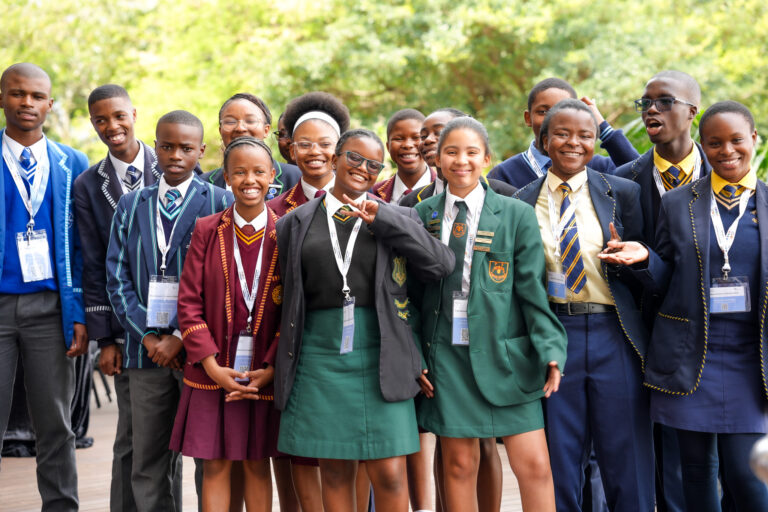
To celebrate National Science Month, NRF-SAEON and the Nelson Mandela Bay Science and Technology Centre hosted Grade 9–11 learners for a hands-on citizen science activity at Pollock Beach in Gqeberha. Guided by Elwandle Node researchers, learners surveyed meso- and microplastics using simple scientific methods, explored how scientists monitor coastal pollution, and gained insight into careers in ocean science through a visit to the Ocean Science laboratory.

Read More »